Upper Abdomen

Epigastric Hernia
Surgery in Chennai

Get the best epigastric hernia surgery in Chennai from Dr. Kumar, the leading upper abdomen hernia specialist in Chennai. Experience advanced keyhole and robotic repairs for optimal recovery.

Understanding

What is an Epigastric Hernia?

An epigastric hernia develops along the linea alba, the fibrous band in the center of the abdomen, specifically in the area between the belly button (umbilicus) and the breastbone (xiphoid process).

The linea alba is formed by the joining of the abdominal muscle sheaths at the midline. Small defects can allow fat from inside the abdomen to protrude, creating a visible or palpable bulge.

Key Characteristics

Midline Location

Located specifically in the upper midline between the belly button and the breastbone.

Often Small

Typically small defects containing preperitoneal fat, though they can occasionally enlarge.

Gender Bias

Epigastric hernias are about three times more common in men than in women.

Congenital Factor

Often present at birth due to a weakness or opening in the fibrous linea alba.

Triggered by Strain

The bulge may appear or become more prominent during physical exertion, coughing, heavy lifting, or straining.
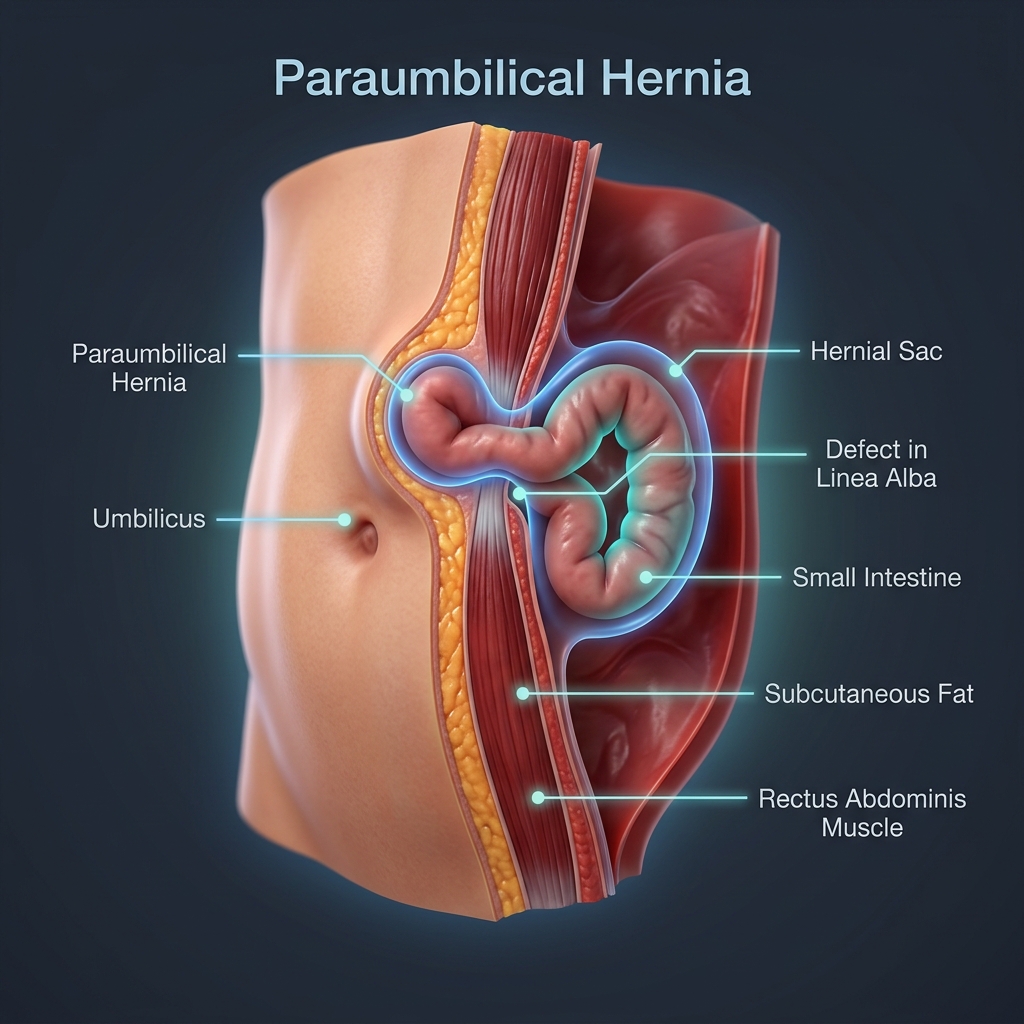
Epigastric Hernia anatomy
Recognition

Signs & Symptoms

Recognizing epigastric hernia indicators early helps prevent progressive complications.

Symptom Consultation

Clinical Guidance

Professional evaluation is recommended for persistent midline bulges.

Visible Midline Bulge

A small bulge or lump felt between the belly button and chest, especially when standing or straining.

Pain or Discomfort

Aching pain in the upper abdomen that may worsen with activity, coughing, or lifting heavy objects.

Intermittent Bulge

The bulge may come and go, appearing more prominent during physical activity and reducing when lying down.

Feeling of Fullness

Feeling of fullness or heaviness in the upper abdomen, particularly after meals.

No Symptoms

Many small epigastric hernias are incidentally discovered and cause no symptoms at all.

Emergency Signs

Severe pain, nausea, vomiting - may indicate strangulation requiring immediate medical attention.

Risks

Potential Complications

If left untreated, epigastric hernias can lead to serious complications.

Incarceration

The hernia contents become trapped and cannot be pushed back in. This can cause pain and requires urgent medical attention.

Strangulation

Blood supply to the trapped tissue is cut off, leading to tissue death. This is a medical emergency requiring immediate surgery.

Bowel Obstruction

If intestine becomes trapped, it can lead to blockage causing nausea, vomiting, and inability to pass gas or stool.

Why Surgery?

When Repair is Needed

Reasons for Surgical Repair

Symptomatic hernias causing pain or discomfort
Larger hernias (generally over 2cm)
Increasing in size over time
Risk of strangulation or obstruction

Surgical Approach

Small incision directly over the hernia
Mesh reinforcement for larger defects
Daycare procedure for most cases
Excellent success rates with low recurrence
Personalized Consultations

Ready to Discuss Your Treatment?

Book an appointment with Dr. Kumar today for a comprehensive evaluation of your condition.

Surgical Approaches

How Dr. Kumar Repairs Epigastric Hernia

Dr. Kumar specializes in advanced minimally invasive techniques. Laparoscopic and Robotic approaches are preferred for faster recovery, less pain, and tiny scars. Open repair is reserved for select cases.

★ Preferred Approach

Advanced Laparoscopic Epigastric Hernia Repair

Minimally Invasive · Keyhole Surgery

Minimally invasive epigastric hernia repair using 3 tiny incisions and a high-definition camera. Mesh is placed in the sublay position (behind the muscles) — the strongest biomechanical repair with the lowest recurrence rate. Faster recovery and minimal scarring.

  • Sublay mesh placement
  • Same-day discharge
  • Tiny incisions
  • Less than 1% recurrence
★ Preferred Approach

Advanced Robotic Epigastric Hernia Repair

Latest Technology · 3D Vision

State-of-the-art advanced robotic platform for unmatched precision, 3D visualization, and wristed instruments — particularly useful for multiple epigastric defects, recurrent hernias, and combined upper-abdominal wall reconstruction.

  • Superior 3D HD vision
  • Wristed instrument precision
  • Best for multiple defects
  • Detects occult defects
When Needed

Open Epigastric Hernia Repair

Time-tested open technique (mesh repair) reserved for select cases — large, infected, contaminated, or emergency hernias, and patients unsuitable for keyhole surgery.

🤷‍♂️ FAQ

Frequently Asked Questions

An epigastric hernia is a protrusion of fat or internal tissue through a defect or tear in the midline of the upper abdomen (the linea alba), specifically in the region between the belly button and the breastbone.