Get the best hiatal hernia surgery in Chennai from Dr. Kumar, a top gastrointestinal and hernia specialist in Chennai. Experience advanced laparoscopic and robotic fundoplication for lasting relief from reflux.
Understanding the relationship between hiatal hernia and gastroesophageal reflux disease.
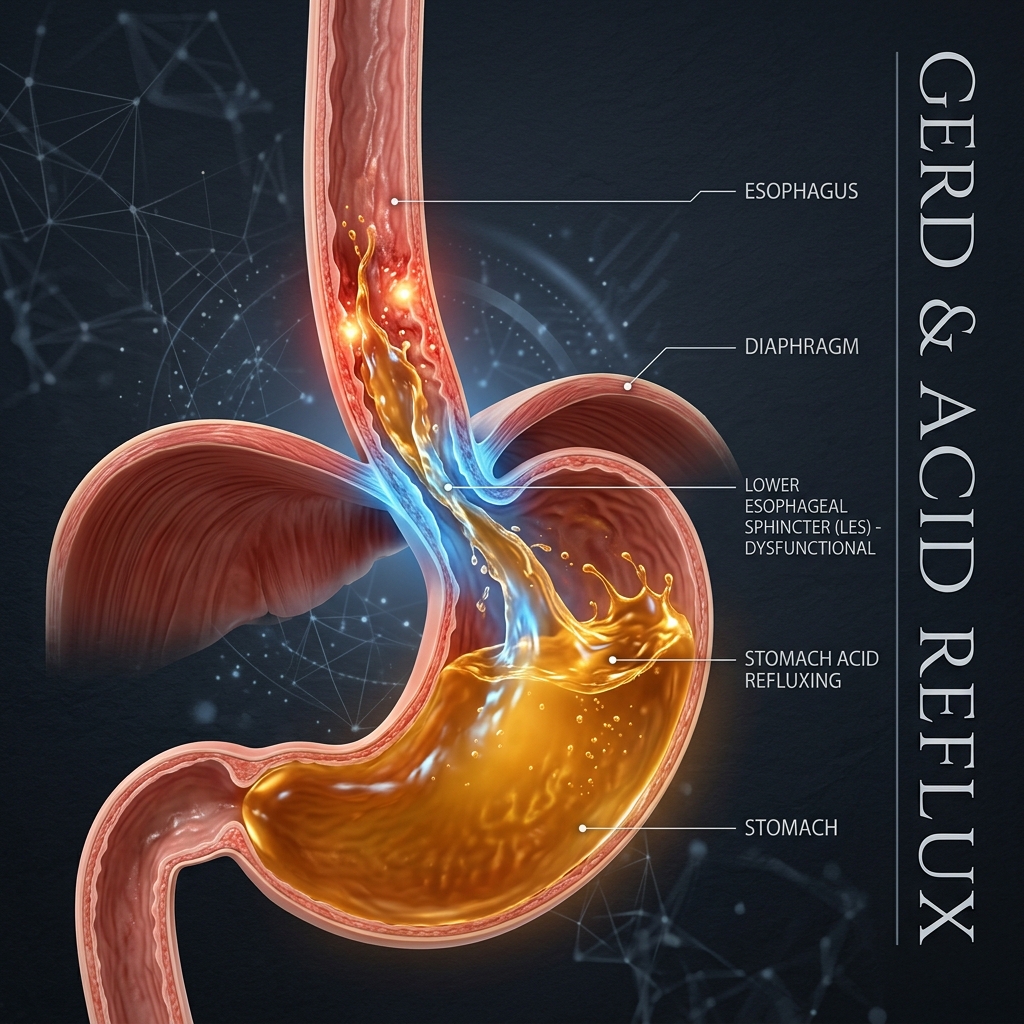
The diaphragm has a natural opening called the hiatus where the esophagus passes through to connect with the stomach. When part of the stomach bulges through this opening, it is called a hiatal hernia.
This hernia disrupts the normal barrier mechanism that prevents stomach acid from flowing back into the esophagus, leading to chronic GERD symptoms.
Important: Over 90% of patients with GERD have some degree of hiatal hernia. Treating the hernia can significantly improve reflux symptoms.
Most common type where the stomach slides up and down through the hiatus. Usually causes reflux symptoms.
Part of the stomach pushes alongside the esophagus. More concerning as it can lead to strangulation.
Combines features of both sliding and paraesophageal types, carrying risks of both conditions.
Burning sensation in the chest, especially after meals or when lying down. The most common symptom.
Often mistaken for cardiac pain. Can be severe and accompanied by difficulty swallowing.
Feeling of food stuck in the chest or throat. May indicate significant hernia size.
Excessive burping and feeling of fullness even after small meals.
Sour or bitter-tasting acid coming back up into the mouth, especially at night.
Chronic throat irritation and voice changes from acid affecting the vocal cords.
Tailored anti-reflux procedures performed laparoscopically or robotically.
Full 360-degree stomach wrap around the lower esophagus. The most common and effective technique for severe reflux control.
Partial 270-degree wrap. Often preferred for patients who have weak esophageal motility to avoid postoperative swallowing issues.
Performed simultaneously to restore the stomach to its correct position below the diaphragm and close the hiatal opening.
Book an appointment with Dr. Kumar today for a comprehensive evaluation and personalised treatment plan.
+91 89255 02759
Tap to call
Dr. Kumar specializes in advanced minimally invasive techniques. Laparoscopic and Robotic approaches are preferred for faster recovery, less pain, and tiny scars. Open repair is reserved for select cases.
Minimally Invasive · Keyhole Surgery
Laparoscopic hiatal hernia repair with fundoplication (Nissen 360° or Toupet 270°) restores the stomach below the diaphragm and reconstructs the anti-reflux valve. Tiny incisions, minimal pain, and rapid return to normal eating — typically 1–2 day hospital stay.
Latest Technology · 3D Vision
State-of-the-art advanced robotic platform for unmatched precision in the confined space around the diaphragm and oesophagus. Superior for large hiatal defects, para-oesophageal hernias, and re-do anti-reflux surgery.
Time-tested open technique (mesh repair) reserved for select cases — large, infected, contaminated, or emergency hernias, and patients unsuitable for keyhole surgery.
A hiatal hernia occurs when the upper part of the stomach slips upwards through the opening in the diaphragm (the hiatus) into the chest cavity. This displacement weakens the natural valve between the esophagus and stomach, allowing gastric acid to escape upwards and cause chronic acid reflux (GERD).